Title : Coefficient Of Block Friction
Aim: To determine the co-efficient of friction between wood and glass.
Apparatus: Glass pane, wooden block, pulleys and weights.
Theory: When one body moves, or tends to move tangentially over the surface of the other, it experiences a force which opposes the motion. This force acting opposite to the direction of motion is called friction.
- Angle of friction: The normal reaction and the frictional force can be combined into one
single resultant force. The angle which this resultant makes with the normal reaction is
called angle of friction. It in denoted by Φ.
tan φ = μ:
Where μ is co-efficient of friction. - Co-efficient of friction (μ) : It is the ratio of limiting frictional force to the normal
reaction.
μ = F / N
where F is the frictional force
N is the normal reaction
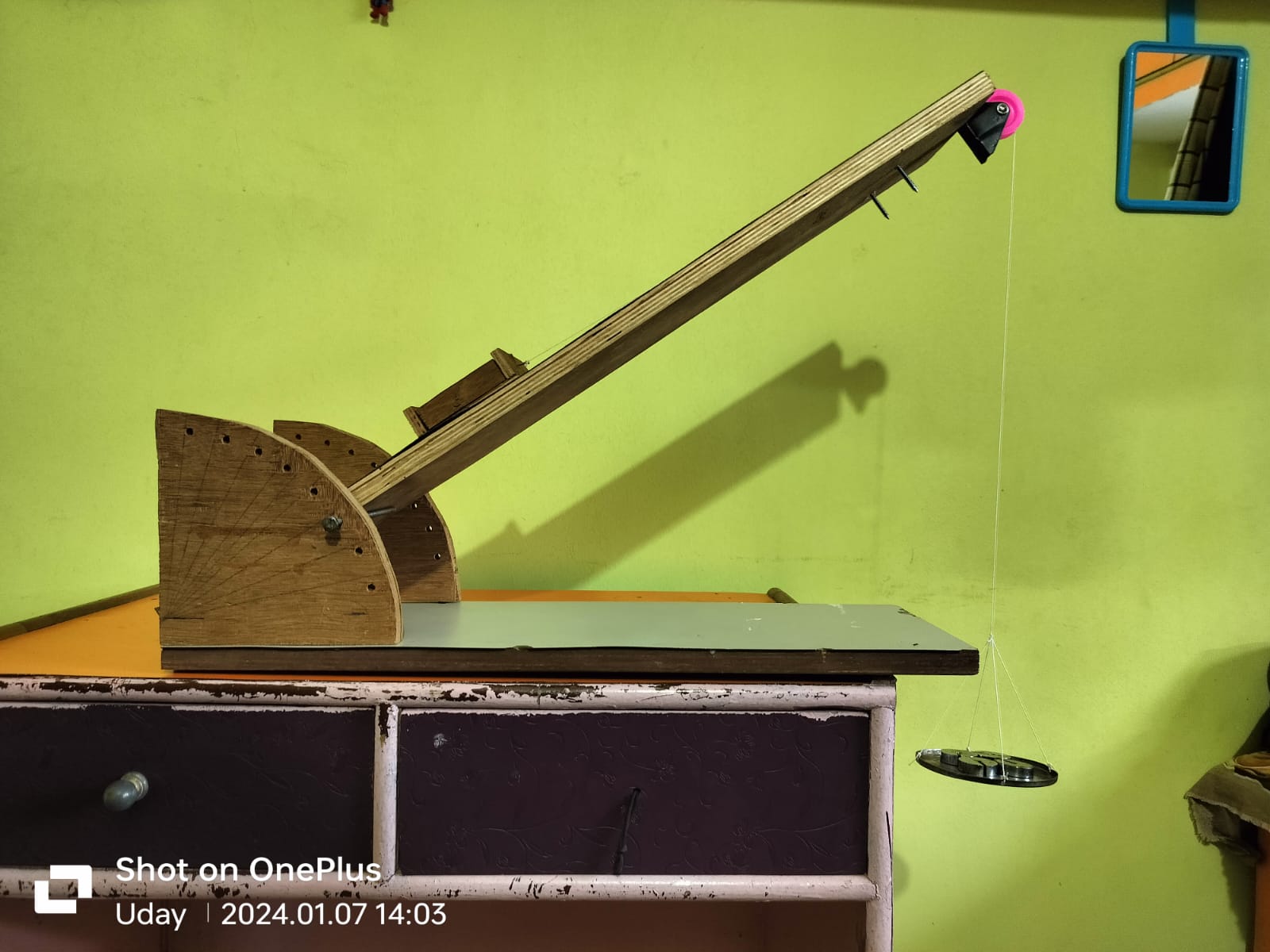
Procedure:
- Set the plane horizontally either with the help of a spirit level or by making the inclination of the plane 0º.
- Take a string with a pan attached to it and pass the string over the pulley fixed to the plane in such a way that the string is parallel to the plane.
- Attached to the other end of the string, is a wooden block kept on the plane.
- Place the weights in the pan and record the weights in the pan. Record the weight at which the wooden block is about to move.
- Repeat the procedure by placing different weights on the wooden block for two more readings.
Observation Table :
| Sr. No. | Surface 1 | Surface 2 | W (weigth of pan) | P (weigth of efforts) | θ (Angle between surfaces) | N (Normal Force) | μmax |
|---|---|---|---|---|---|---|---|
| 1 | Glass | Sunmica | 235 | 228 | 23 | 216.31 | 0.62 |
| 2 | Glass | Sunmica | 335 | 368 | 30 | 290.11 | 0.69 |
| 3 | Glass | Sandpaper | 235 | 248 | 23 | 216.31 | 0.72 |
| 4 | Glass | Sandpaper | 335 | 378 | 30 | 290.11 | 0.72 |
Result: Coefficient of static friction for different surface is calculated.