Title : Projectile Motion
Aim: Projectile motion is a path traveled by an object influenced by the initial
velocity, launch angle, and the acceleration due to gravity. In this
experiment you will predict the spot a steel ball will land after being
launched.
Apparatus: Computer
,Vernier Projectile Launcher
,Vernier lab quest
,Small cardboard box
,Steel ball
,Meter stick
,Waxed paper
Initial Setup:
- Position the launcher next to the edge of your table. Eventually you
will fire a ball horizontally that will travel several meters, so plan for
this when choosing a location.
- Use the lower knob on the back of the unit to adjust the position of
the launch chamber until level. Then tighten the knob to maintain this
position.
- Next, use the upper knob on the back of the launcher to set the scale
to 0 degrees. Move the scale so the notch of the launcher chamber is
at 0 degrees. This setting accounts for deviation of the tabletop from
horizontal.
- Connect the projectile launcher to the labquest.
- Connect the hand pump to the projectile launcher. Set the release
pressure by adjusting the range knob. Turn the knob clockwise for
higher pressure and higher launch speed. Turn the knob counterclockwise for lower pressure and lower launch speed.
- Remember to select a release pressure that is appropriate. Keep
pumping the pump until you hear at least three small release sounds,
then wait for the pressure to stabilize which should be about five
seconds. Also do not change the release pressure for the rest of the
lab or your prediction will be incorrect.
Diagram:
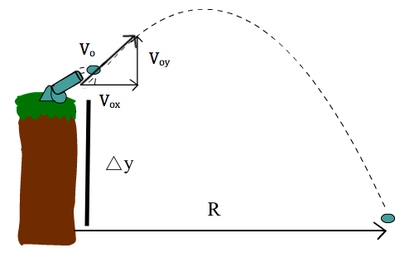
Procedure:
-
First insert the steel ball into the launch chamber with your index
finger and push the ball into the barrel.
-
Pump the hand pump until it reaches your selected pressure. Now
keep pumping until you hear the three small release sounds. Wait five
seconds for the pressure to stabilize.
- Collect data using the following steps:
- Click the “collect” button to start data collection.
- Hold the cardboard box so you can catch the ball right after it
leaves the projectile launcher. Do not let the ball hit the floor.
This is important.
- When you want to launch the ball, press and hold the arm
button, and then press the launch button.
- Record the speed in the data table.
-
Repeat this process, catching the ball with the cardboard box until you
complete a total of 10 launch speed measurements. Record the values of
the speed in Table 1.
-
Review your speed data of each trial and calculate the average speed
values and identify the maximum and minimum values. Record those
values in Table 2.
- Determine the launch height by:
- Measuring the distance for the tabletop to the floor.
- The launch chamber of the projectile launcher is 0.146 m above the
surface of the table. So determine the total distance the ball will fall.
- Record this total height value as the launch height, in table 2.
- Identify the floor origin and table offset:
- The launch point is clearly marked on the projectile launcher. Position
the projectile launcher so that you can figure out the distance from
the launch point to the edge of the table, in line with the launch barrel.
You will need this offset distance for later calculations. Record the
offset values in table 2
- Use a meter stick to locate the floor location just below the table
edge. Mark this point with table as it will serve as the floor origin.
- Determine the predicted impact point range:
- Use the average speed value to calculate your prediction for the
range. The range is the horizontal distance the ball will travel. Record
this prediction as the predicted range for the average speed in Table
3.
- Subtract the table offset from the predicted range and record that
value in Table 3 for predicted floor distance for the average speed.
- To account for variations seen in the speed measurements, repeat
the calculation for the minimum and maximum speeds. These two
new points show the limits of impact range to be expected,
considering the variations of the speed measurements. Record the
predicted ranges and floor distances for the max and min speeds on
the data table.
- . Tape a piece of waxed paper to the floor that is big enough to account
for the different variations that you previously calculated. Remember that
the waxed paper must be lined up with the launch chamber.
- Next launch the ball and allow it to strike the floor for the first time.
Measure the distance from the floor origin to the actual impact point and
enter the floor distance in the Table 4. Now calculate the range for the
actual impact.
Observation Table :
A) u = constact
:
| Sr. No. |
Initial Velocity |
θ |
Range |
Height |
Time of flight |
| 1 |
10 |
25 |
7.7 |
0.91 |
0.86 |
| 2 |
10 |
30 |
9 |
1.275 |
1.02 |
| 3 |
10 |
45 |
10 |
2.55 |
1.44 |
| 4 |
10 |
60 |
8.9 |
3.824 |
1.77 |
B) θ = constact
:
| Sr. No. |
Initial Velocity |
θ |
Range |
Height |
Time of flight |
| 1 |
5 |
30 |
2.2 |
0.31 |
0.51 |
| 2 |
10 |
30 |
8.3 |
1.275 |
1.02 |
| 3 |
15 |
30 |
20 |
2.67 |
1.53 |
| 4 |
20 |
30 |
35.5 |
5.1 |
2.04 |
Result: Height, Range and time of flight is calculated
Projectile Motion Calculator